.png)
If you're new to sourcing guar gum, the terminology alone can be confusing — split, korma, food grade, industrial grade, cps, mesh size. This guide walks through what guar gum actually is, how it's processed, and the specifications worth asking your supplier for before you commit to an order.
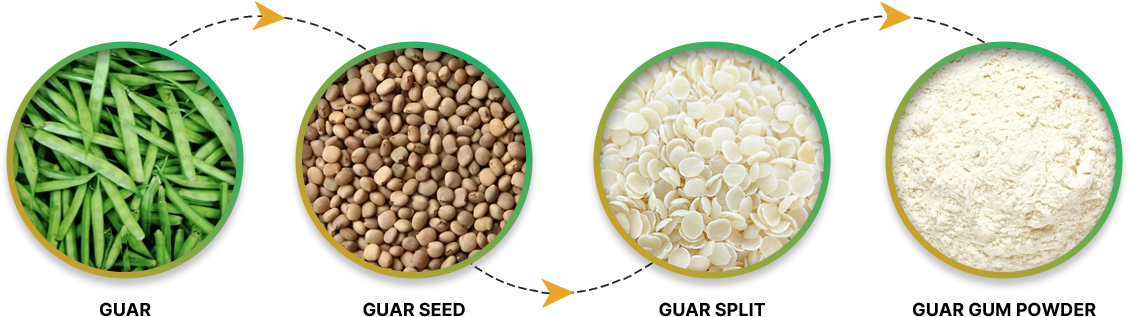
Guar gum is a natural hydrocolloid extracted from the endosperm of the guar bean (Cyamopsis tetragonoloba), a legume grown widely across Rajasthan, Gujarat and Haryana in India. Once dried, the guar seed is split, and the endosperm — the gum-yielding part — is separated from the germ and husk. That endosperm is either sold as-is (guar split) or ground further into guar gum powder.
What makes guar gum commercially valuable is its ability to thicken water at very low concentrations. A small quantity mixed into water dramatically increases viscosity, which is why it shows up in everything from ice cream to oil well fracturing fluid.
The same base powder can be processed and tested differently depending on the end use:
Whichever grade you need, ask your supplier for a certificate of analysis covering:
| Parameter | Why it matters |
|---|---|
| Viscosity (cps) | The core performance metric — how much a given concentration thickens water. Higher viscosity grades command a premium. |
| Mesh size / particle size | Finer mesh generally hydrates faster; coarser mesh is common for slower-release industrial applications. |
| Moisture content | Affects shelf life and effective concentration — typically specified at or below 12%. |
| Protein & AIR (Acid Insoluble Residue) | Indicates purity — lower AIR generally means a cleaner, higher-grade product. |
| Microbial limits | Relevant for food-grade material — total plate count, yeast & mold, E. coli, Salmonella. |
| pH | Should fall within a specified range depending on the application. |
A supplier who can hand you a detailed certificate of analysis without being asked twice is usually one worth building a long-term relationship with.
Sunrise Grain manufactures across the full guar range — seeds, splits, gum powder, meal and roasted korma — with specification sheets available for each grade. You can see the detailed specs, packaging and export information on our guar products page.
Tell us your required grade, viscosity and destination port, and we'll send samples and a formal quote.
Request a Quote