.png)
High-quality wheat suitable for food, feed, and industrial applications.
 FSSAI
 HACCP
 ISO 22000
 HALAL
 APEDA
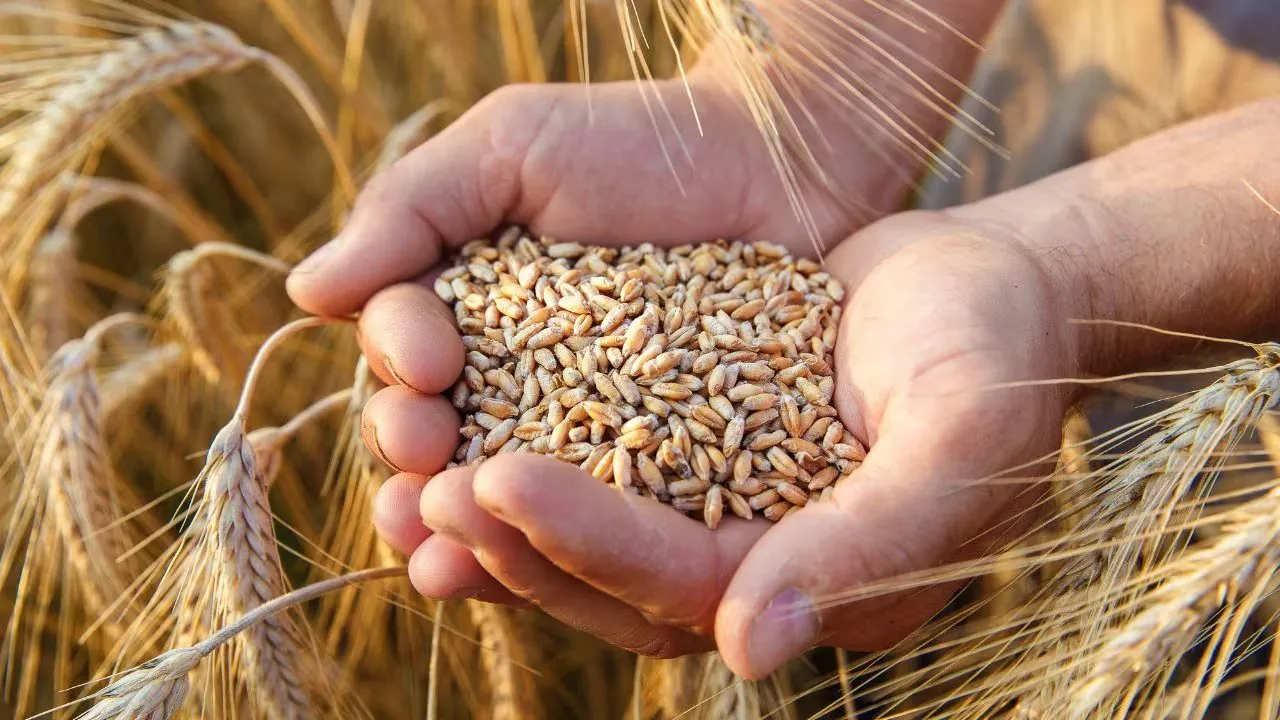
Sunrise Grain exports milling-grade wheat to flour mills, food manufacturers, and wholesale distributors internationally. Sourced from Rajasthan's wheat-growing belt and quality-checked before dispatch, our wheat meets consistent protein, moisture, and purity specifications required for commercial milling. . As an Indian wheat exporter, we supply milling-grade wheat to flour mills, bakery buyers and food manufacturers across the Middle East, Southeast Asia and Africa. Both durum and common bread wheat varieties available in bulk FCL and bulk-vessel quantities.
Wheat pricing follows seasonal crop conditions — contact our team for current FOB rates and available quantities.
What a buyer can plan for in a 20 ft or 40 ft container of Wheat, and the packing options we export under.
Common questions buyers ask about sourcing Wheat from Sunrise Grain.
Standard MOQ is one 20ft FCL (18-20 MT typical) for competitive bulk pricing. Trial samples (1-5 kg) are available on request so you can validate quality and specifications before committing to a full container.
15-21 days from confirmed PO to container loading, depending on order size, grade, and packaging requirements. Rush orders can be accommodated subject to current production schedule — please confirm with our team at inquiry stage.
We export to 35+ countries across the Middle East, Southeast Asia, Africa, China, Europe, and the USA. Full export documentation — phytosanitary certificate, certificate of origin, quality test reports — is prepared by our in-house team.
FSSAI, HACCP, ISO 22000, and HALAL certified facility, with APEDA registration. Every batch is tested for the specifications listed above before dispatch. Third-party lab reports, mill test certificates, and specification sheets are provided with each shipment.
Yes. Mesh size, moisture spec, bag weight, outer packaging, and private-label artwork can all be customized to buyer requirements. Minimum customization varies by spec — share your requirement in the inquiry form and we'll confirm feasibility and MOQ.
Yes. Paid samples (1-5 kg) with full specifications and quality report are shipped globally within 7-10 days. Sample cost is credited against the first bulk order.
Hand-picked next steps for buyers researching this category.
What international buyers should know when sourcing Indian wheat.
Common wheat (Triticum aestivum) is used for bread, chapati, rotis, biscuits and most everyday bakery. Durum wheat (Triticum durum) is a harder variety used primarily for pasta, semolina and some flat-breads. India produces primarily common wheat; durum is grown on smaller scale in Madhya Pradesh.
The main growing belts are Punjab, Haryana, Uttar Pradesh, Madhya Pradesh and Rajasthan. The rabi (winter) crop is sown in October-November and harvested in March-April.
Indian wheat delivers 10–13% protein depending on variety and growing region. Higher-protein wheat is better for yeast-leavened breads; lower-protein for chapati, cookies and biscuits. Moisture at loading should be below 12%.
Indian wheat exports are periodically regulated by the government to protect domestic supply. Current export status depends on crop estimates and strategic reserves — always confirm export licence availability with your supplier before contracting.
Common buyer questions on this product — matched to the queries buyers actually type into Google.
10–13% depending on variety and growing region. Higher-protein wheat is suited to yeast-leavened breads; lower-protein wheat suits chapati, cookies and biscuits.
The main growing belts are Punjab, Haryana, Uttar Pradesh (collectively 'the wheat bowl of India'), Madhya Pradesh and Rajasthan. Sowing is October-November, harvest March-April.
1001.99 (wheat other than durum, seed, meslin). 1001.19 is for durum wheat other than seed.
Indian wheat exports are periodically regulated by the government to protect domestic supply. Always confirm current export policy and licence availability with your supplier before contracting.
Flour milling for bread, chapati, cookies, biscuits, pasta (durum). Some grades are used for cattle and poultry feed when prices make it economical.
18–24 months in cool, dry storage below 12% moisture. Insect protection during long storage is important; fumigation at loading is standard practice for FCL shipments.
One 20ft FCL (24–26 MT) for FCL buyers. For bulk-vessel loading (5,000+ MT), separate commercial terms apply.
During allowed export windows: UAE, Saudi Arabia, Yemen, Oman, Qatar, Sri Lanka, Bangladesh and some African markets. Government export policy determines which destinations are open at any given time.